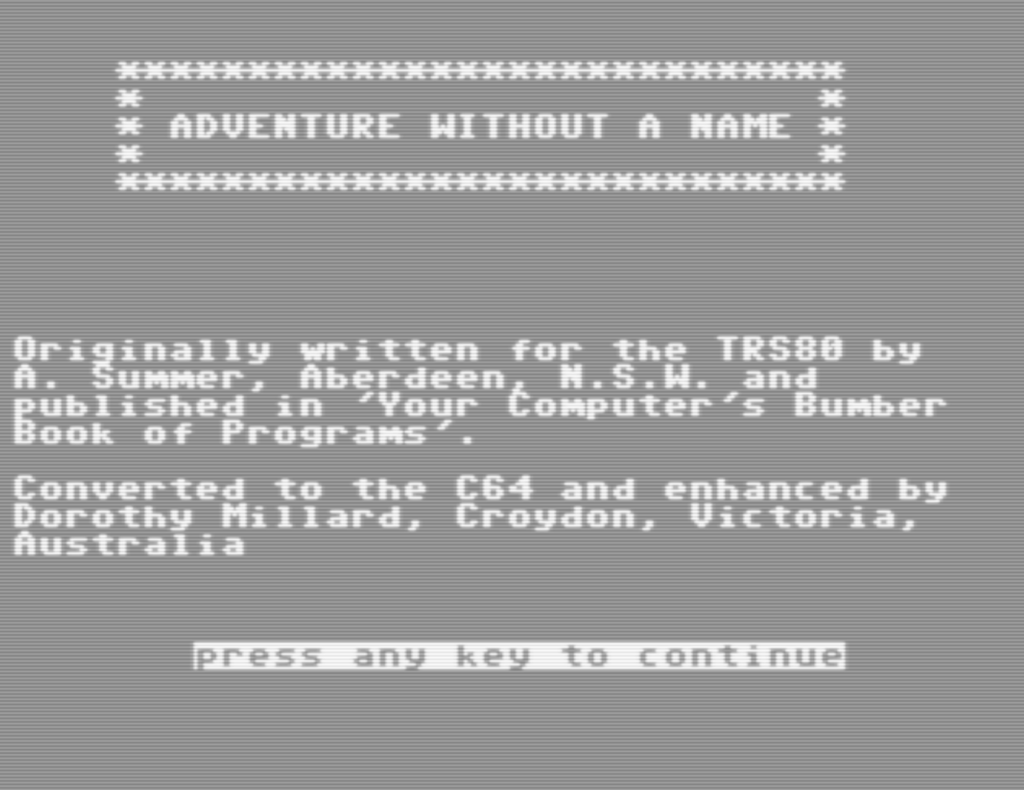
Another adventure to satisfy the wanderlust before February is over, just about. We’re still firmly in the ‘A’s and this month’s adventure has no name. Or at least, it is called Adventure Without A Name. Not to be confused, confusingly, with Adventure With No Name, which was a TRS80/BBC type-in adventure by the same author, A.Summer. This is a C64 conversion of that game enhanced by the legend, Dorothy Millard.
Although originally a type in, this game was published by The Guild, a homegrown software label set up by Tony Collins, himself an adventure game author in 1991, who ran the label until the autumn of 1993. As well as self published games, and those from other authors, The Guild built up a large public domain collection, and this game was one of those. We’ll likely come across quite a few of The Guild’s titles during our adventures.
Originating as a type-in this game is obviously written in BASIC and is a pretty small, text only adventure.
So, our buccaneering reputation preceding us, we have been chosen to recover some gold for some prince or other from a dangerous, fierce dragon. The prince needs this gold to fight an evil king, apparently.
We start, as we so often do, at the entrance to a cave.
There is nowhere really to go except into the cave, so we do that. We find ourselves in a passage leading south. Being small, we can’t expect too much from the parser, and although a door is mentioned there is nothing that can be done with it. Even LOOK DOOR tells us nothing. I guess we ignore that for now then.
There is a boat at the bottom of this passage which we can miraculously pick up and carry, but without giving too much away, it is of little use yet.
This is very standard adventuring stuff – with the help of pencil and notepad to map out moves we soon find our way around to the door we saw at the entrance to the cave, picking up the obvious things we come across along the way. The parser, as mentioned above, is very limited – the usual commands don’t work and the game uses LOOK instead of EXAMINE which always jars me, but it is just about usable. It can be frustrating though, especially as it recognises TOSS but not THROW, for example.
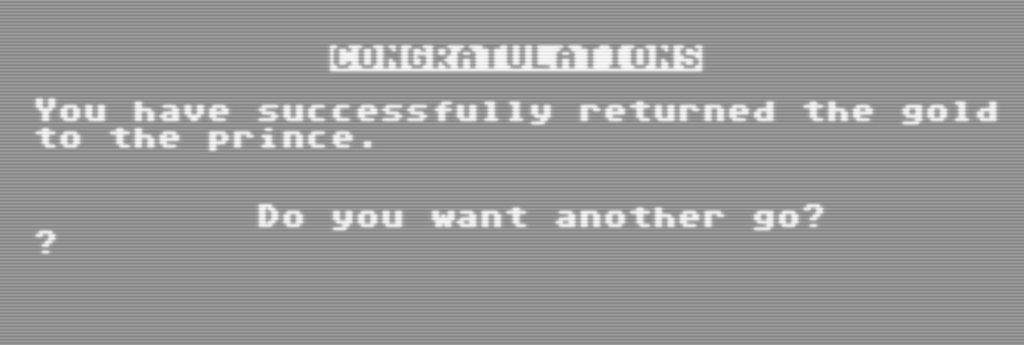
So, back to find the dragon (if you found the dragon too soon you’ll realise now the power of the sword!) and the gold. A fairly simple puzzle presents itself to escape back down to the boat storage area and to a more useful boat, before we can get to the prince and give him the gold.
No. No, I don’t want another go.
A quick adventure (15 mins max?) and with the aid of a mapping tool or good old pencil and paper it is extremely easy to solve, the poor parser aside. I would have been happy enough with this as a type-in but if I’d spent any money on this it would be very disappointing. Having said that, I have played worse games 😂
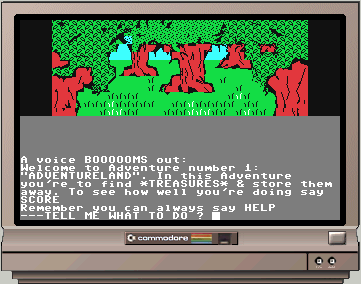
Next time we’ll be playing Adventureland from 1980, released by Adventure International (Thunder Mountain in the USA). Actually, we’ll play the 1984 graphic version of the game.
Until then, try not to get hoisted on your own, or anybody else’s, petard.
Going to sneak this one in and hope nobody notices. It should have come before Adventure Quest as it is (just about) a published game, albeit little known about.
Ray Hoffmeister coded this game (an appropriately beery retro name!) in CBM BASIC and it’s the only one attributed to him on Gamebase 64, but it is recorded as being published by Binary Zone PD who have been around since 1990. Binary Zone distributed public domain games on disk and cassette and are still around today.
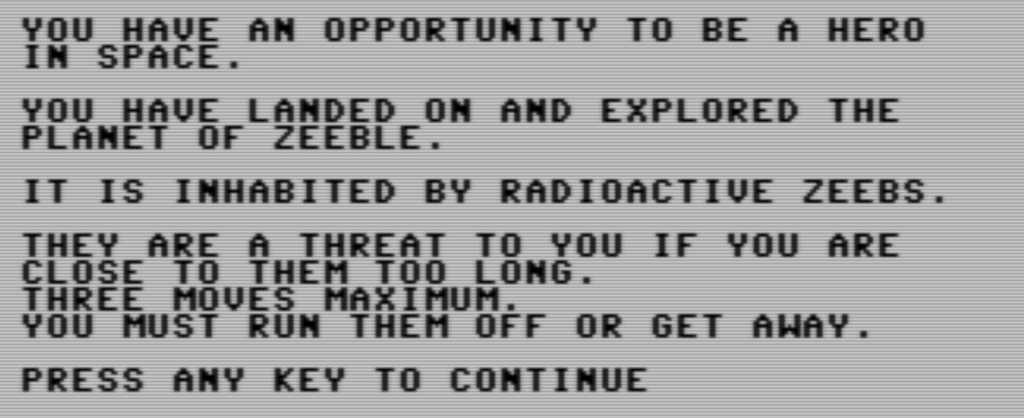
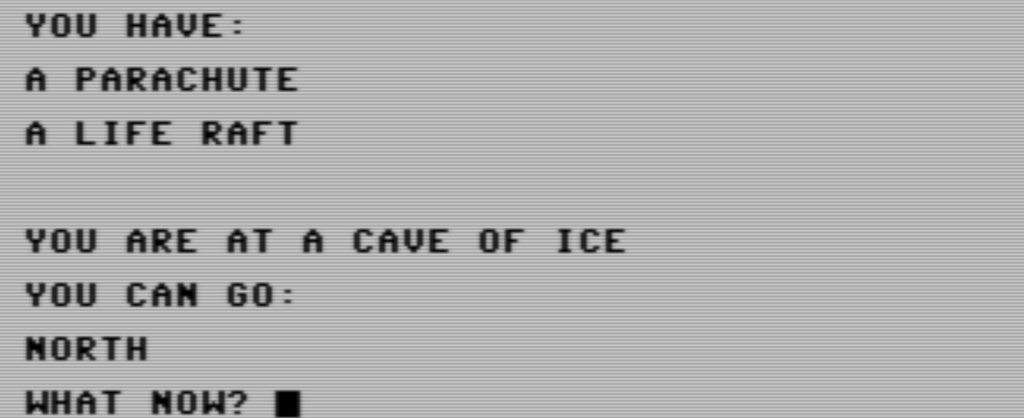
On loading up the tape image we’re presented with the above screen before being told we have a limited supply of air and a back pack that will only carry 3 items. Putting the familiar sinking feeling one gets with these PD games to one side, let’s see what the planet Zeeble has in store for us…
This is one of those adventures that has minimum location descriptions, but reveals a lot more when you type ‘look’, so the key here is to move, map and look around. It’s a small adventure, and limited in terms of vocabulary and has a weak parser. It also isn’t particularly logical and gets stuck in some place. Having said that I quite enjoyed it.
If you look around and there is an object in your location, you’ll generally need to pick it up for use later on. Some clever swapping of items is required to keep within the pack limit of 3. You should eventually end up at a cave of ice and, ahhhh, there are Zeebs here! If you got here before finding the things you need (namely stones and a pistol) then run away and find them.
Once the Zeebs scramble and the ice door of the cave is melted, you move inside. Some annoying logic follows with dropping stuff and picking stuff up, but you should eventually end up in the cave, near a metal chest carrying a raft and a parachute.
Getting the chest open is a bit annoying. If you are using VICE or the C64 Ultimate save a snapshot as you can easily blow the thing up and you’ll need to start again. The key is to keep the chest ticking softly. If it ticks loudly then that press is wrong. Start with one colour, then trial and error until you get all three ‘softly’ options and the chest clicks open.
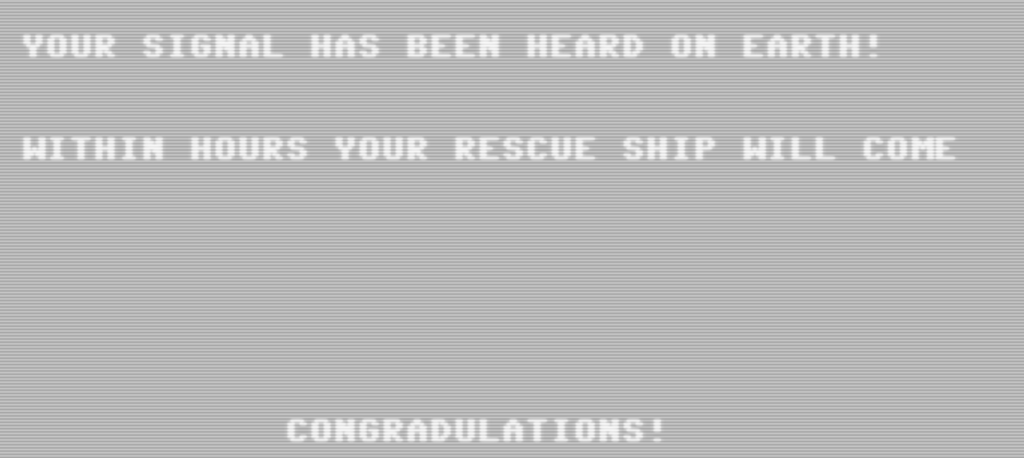
Once that’s done we want to go back to the high mountain where we first used the rope (you’ll need it again here) and drop the raft. Then a jump and a climb down with the rope lands us in an area where there is a radio waiting to be fixed with the wire. Do that, turn the radio on, and Bob’s your Zeeble.
And that is our reward, complete with spelling mistake.
This small adventure played ok, a little inconsistent and slow in terms of code and the parser really struggled at times depending on location, but it worked, it was fairly logical in that the player knows what they need to do. It reminded me a lot of PD games I used to be able to afford and although I can’t remember ever playing this one, I think it would have certainly provided enough entertainment in a late peanut butter sandwich and coke fuelled afternoon.
Back in sequence next time with Adventure Without A Name from The Guild Adventure Software.
Right, where was I? Oh yes, just finished up escaping from Cleopatra’s Pyramid, had a little break (19 months), got myself a brand new Commodore 64 Ultimate, had a nice cup of tea and thought it was about time to get back in the saddle.
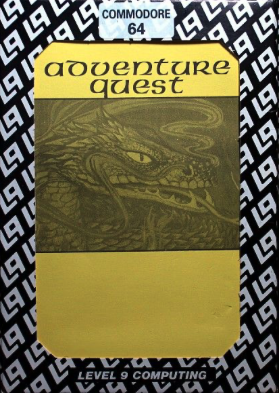
As it happens we’re on to one of the proper big titles now. 1982’s Adventure Quest from Level 9. Level 9 games were my hearts desire in 1982/84. I used to look longingly at adverts in magazines, but they were either only available on disk, out of my price range, or very often both. Eventually cheaper cassette versions did start appearing in the UK (not all though, if I am remembering correctly) and I certainly did manage to get hold of a couple, but they were still very expensive for my pocket money budget. When I first got back into the C64 around 15 years or so ago, Level 9 adventures were the first titles I collected. It was simply impossible for me to envisage back then how readily available all the commodore software would be today and how easy it is to use thanks to kit like the Ultimate 1541 and the new 64 Ultimate.
Adventure Quest was not Level 9’s first game but it was the first alphabetically, and as I am sticking to that ridiculous notion, it comes next in the list. It is part 2 of a trilogy of games, initially released separately, which featured themes and names inspired by (stolen from) the books of J. R. R. Tolkien and so became known as the Middle-Earth Trilogy before being expanded and rereleased together in 1986 as a compilation. At that point the references to Middle Earth were removed and the trilogy was retitled Jewels of Darkness.
There are many in depth reviews out there of Adventure Quest, so this won’t necessarily be another one, but I will share my thoughts on playing through and try to give a feel for the game.
The first thing to mention is this is a large game for an 8 bit platform, something Level 9 were famous for, and a sophisticated adventure given it all fitted on one disk. As the included manual explains, this is achieved with the use of A Code.
Adventure Quest is not written in ASSEMBLER or BASIC, either of these would have made it too big – and BASIC would also have been too slow. Instead it is written in a super-compact language known as ‘A-CODE’, which is specially designed for writing adventure games.
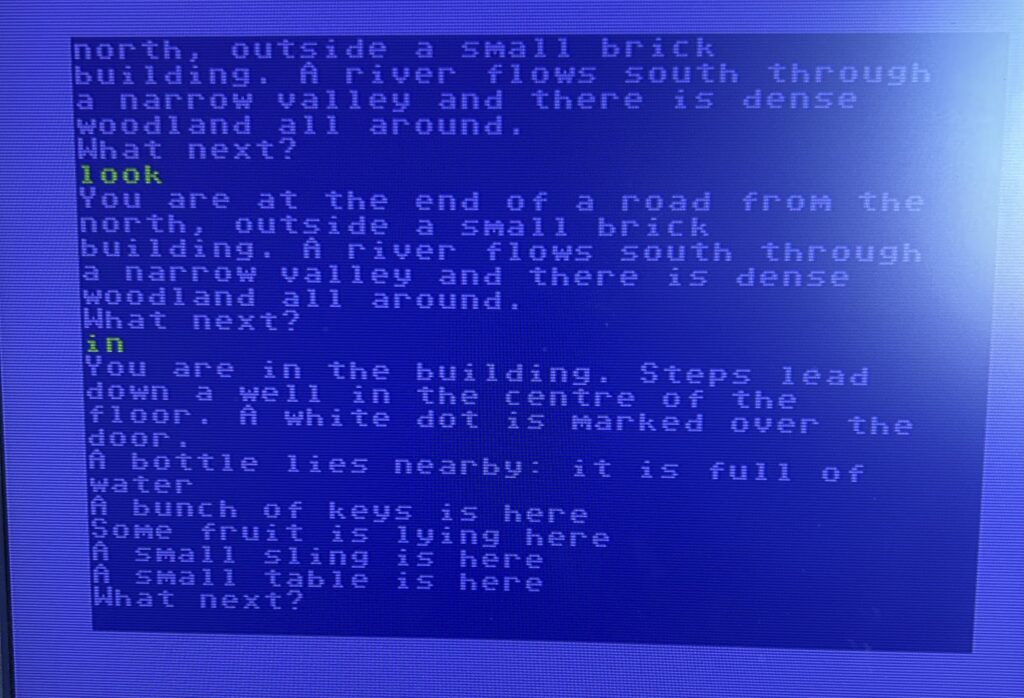
So let’s dive in. We start outside a small brick building and like all good adventurers the first thing to do is probably go inside. Already we are slightly overwhelmed with the amount of objects and information available. This is the point you need to get your notepad and pencil out. Mapping is hugely important and clues will be found along the way, so a notebook should be the first item in the bag when packing your essential adventuring kit.
Without giving too much away, there is just no way you are going to know what to pick up, what to consume, and what to look at in more detail yet without trial and error. And this is what makes these games so great. Unlike a quick blast of Space Invaders, these games occupy your thoughts through school days (or work days!) and solutions and ideas can come to you when least expected. Rush home, try it out, feel on top of the world and move on to the next puzzle. Needless to say, make frequent use of the save feature!
I’m going to cover the first important puzzle here, so read no further if you want absolutely no spoilers.
If you go outside and look around (remember to map everything!) you will come across an area where you are stumbling over sharp stones and you can see a rare orchid two feet above you. Getting here requires getting lost in the forest, a common Level 9 mechanism, but careful mapping and trial and error will help you find your way through. Try every direction, and save, save, save. We need to get that orchid and use it later on to woo a unicorn. If only we had something to stand on! Right. The small table from the brick building. Why didn’t I pick it up when I had the chance? Well firstly you can’t just go around picking up and carrying everything as, like in real life, there is a limit to what you can carry. It’s a good lesson to learn as going back for stuff once the puzzle becomes more clear occurs throughout Level 9 adventures.
If you’ve been mapping correctly, finding your way back to the building should be straight forward. Or, as we haven’t really done too much yet, you could simply ‘quit’ and start back there again. However you do it, note the white dot over the door here. You can’t do anything with it, but white and black dots are important later! Now, get the small kitchen table, ignoring everything else, and retrace your steps to the orchid where you can stand on the table and reach it. NB randomly wolves may start stalking you. You will have a few moves to scare them away by throwing anything at them but if not they will attack and kill you. It’s worth remembering not to go empty handed anywhere! If this does happen, remember to pick whatever item you threw back up.
Worth mentioning also that carrying the table restricts you from climbing other things, such as huge oak trees you may come across. In that case just drop the table, climb up and down and grab the table again. If you’ve been exploring and mapping you’ll know the area I mean. Get to the orchid and drop the table. Simply asking the game to ‘get orchid’ works as it is assumed you are climbing the table at this point.
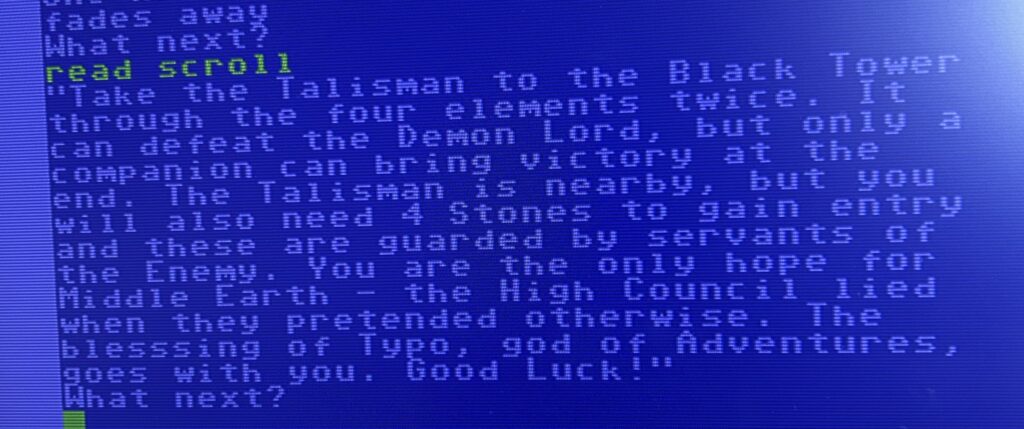
Leave the table there and continue exploring. If you come across an onion (it’s actually garlic) then get it and eat it. We know garlic is very good for warding off certain blood sucking baddies! Continue exploring (and mapping!) and eventually a wizard will give you a scroll to read. Make a note of it in your notebook.
Return to your map and try other directions you haven’t ventured down yet. We need to get to a clearing with a unicorn. You may have already come across it on your travels. Now we have the orchid we can give this to the unicorn and follow it north. There are some pipes to pick up and a medallion, and if you’ve been mapping correctly you’ll see we’re not too far from our starting point, the brick building.
With the scroll clue and the other items we have found it feels like the adventure has just started. And you would be right thinking that.
I have deliberately not given a ‘walkthrough’ of this first area but more of a strong guidance – you’ll find exploring, getting into trouble, back tracking and problem solving will be required throughout this adventure. Who knew unicorns liked orchids for example? That you can’t pick an orchid without a table? That you can’t climb a tree whilst holding a table? Well, maybe I knew that last one. But things like simply throwing any object at the wolves took me an age to realise the first time around.
With all Level 9 games it’s a case of writing everything down, trying and interacting with everything you find in all situations, and thinking firmly outside of the box. It isn’t meant to be easy, but it is meant to be solvable. There is a lot of love for this adventure out there and rightly so, it’s a great advert for the genre.
Oh, and those white and black dots I mentioned earlier? They are teleport dots. Going through an exit with a black dot will transport you back to its corresponding white dot. This is very useful for going back to retrieve objects you have left behind either on purpose or accidentally.
Level 9 were my absolute favourites back in the day. Along with Infocom they provided the very best in adventure gaming and I don’t think these text based games would have survived without those two giants of the genre.
The D64 game file can be found in lots of places on the internet, or there is a browser playable version at the Internet Archive here. And remember, save often, map precisely, and note down everything!
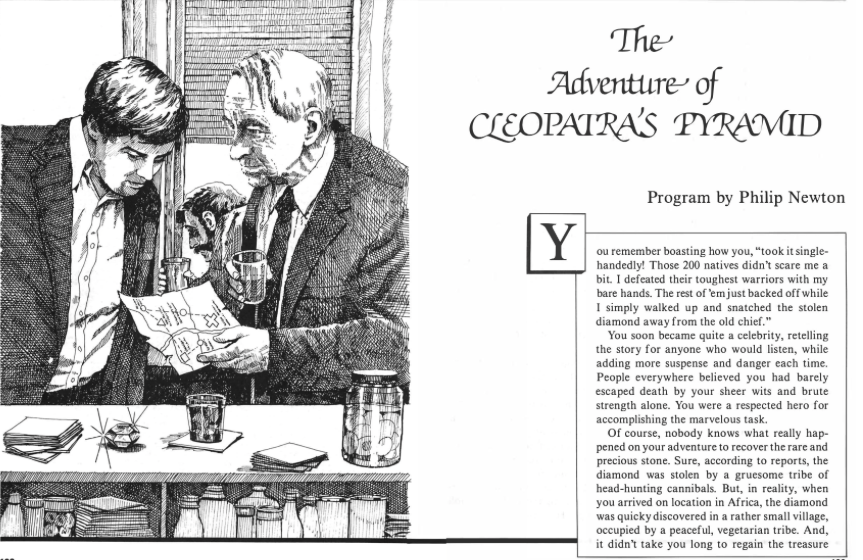
This text adventure is from 1987 and was published by Falsoft Publishing, a publisher of magazines and books, primarily the Rainbow series, and it was in the third Rainbow Book of Adventures that this adventure first appeared. It was released for the TRS-80 Colour Computer and converted across to the C64 in the same year.
Philip Newton is attributed as the original author of the TRS-80 listing, and it looks like Nathan Butcher was involved (or wholly responsible) for the Commodore conversion. I could only find one listing for Philip Newton, this adventure, but Butcher appears to have many listings and releases under his name, mostly conversions, some of which we will no doubt cover in this series.
So, let’s start the adventuring….
We start at our camp, outside the tent and with all four major compass point exits available.
OK, so obvious first move, Enter Tent right? Nope.
I have to say, my heart sinks when this is the first thing you come across. I understand the limitations, believe me I do, but this stuff is important for a good experience. So, after typing VERB and having a look through the limited list, the only one that makes any sense is GO. So, Go Tent, of course.
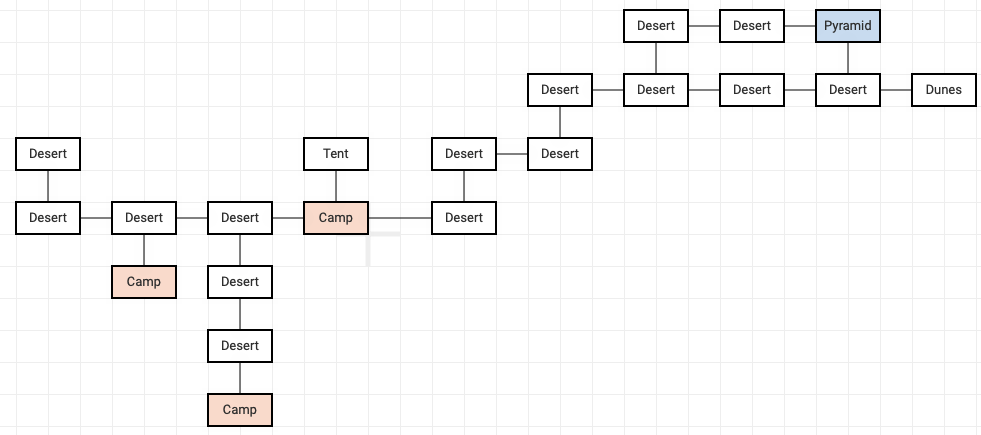
All items appear to be randomly placed in one of two maze locations. The first maze location is the Hot, Sandy Desert, and is a bit of a nightmare. The map doesn’t really make any sense with random directions either taking you back to your camp or another hot, sandy stretch of dessert.
You’ll need to pick up all the objects you find along the way in the Desert, providing you don’t come across the Scorpion of course (it will eventually sting and slowly kill you) and make your way to the Pyramid for the next frustrating maze. You’ll need the Flashlight, Sceptre and Backpack before entering, which you should find in the Desert somewhere, and you should also have dropped all of the treasures found thus far back at the tent.
Once you make your way to the Pyramid, the game is made even more maddening by a randomised roaming mummy who can strip you of your inventory and scatter the items around in the catacomb maze. If you are lucky the mummy ignores you or simply shouts ‘Go Away!’. You can also wave your Sceptre at the mummy sometimes to make it disappear, but you need all the stars to align for this to happen, and you need to have found the items you need in the Desert without being killed by a random Scorpion. The fact you need to go back and forth makes it almost impossible to complete.
If you’re lucky!
I made quite a lot of use of the SAVE feature to stop getting killed or stripped of my possessions too frequently, but it soon became far too tedious to continue. I never did finish getting all 25 treasures back to my tent and quite honestly the sweet, lingering death of a scorpion sting was blessed relief.
It isn’t actually a bad game, certainly not the worst text adventure I have played, but the BASIC listing and typed in nature of the code kind of showed, and an attempt at being cutting edge with randomising mummies and scorpions just made for a frustrating experience. There was too much random luck involved and too little problem and logic solving for my liking.
Having said that, I am already sitting here thinking, well, I got 14 items….maybe I’ll try again for the full 25! I’ll give it some time and maybe revisit one day. That in itself might persuade you to give The Adventure of Cleopatra’s Pyramid a go…
Another hobby (yes, I know! I have many hobbies) of mine is genealogy, and I get the same detective fix finding context about game authors and a little bit about where they are from and what they have done in their lives. It hasn’t taken many text adventure game reviews for me to start seeing a genealogical pattern forming for authors, software houses, distributors, labels etc.
Adventure Land was distributed by The Guild, aka The Guild Adventure Software. We’ve already come across The Guild as it was they that distributed Dorothy Millard’s 1989 game Adventure In Time And Space. Distributed is the right word here, as they only published their own games from about 1991 and anything on their books before that date was either public domain or first published elsewhere.
When The Guild packed it in, a lot of their titles were snapped up by several houses, including Adventure Probe Software. The same Adventure Probe that published the magazines, including the one from my last post featuring J.B.Cattley. So in the course of three consecutive reviews we have a veritable family tree of software.
The Guild and Adventure Probe have links to The Adventure Workshop and Pegasus Software, as well as 50/50 Software and Recreation Re-Creation Software – all of whom have published or distributed text adventure games, so we will learn more about those as we come to them!
Adventure Land was written by Nick Corr, and I have failed miserably to find any firm information out about him. As far as I can tell he only wrote this single game, and I don’t think I am being too harsh when I say I can see why.
Arrrggghh my eyes!
So first off we are told our objective is to locate a golden key (yes, another one) which will enable us to enter a castle and claim our prize. We are warned of goblins and trolls and other magical creatures who are all hell bent on stopping us in our quest. We are also told to look out and memorise (I’ll write them down if that’s ok?) the magical words we may or may not find.
A clue to the complexity of the engine is that we are told we are only allowed one word commands. Fine.
We start in a forest. A large forest, with trees on all sides. Entering a command, any command, just repeats the short description of the forest. So I guess we just have to assume that we can’t do anything other than move in the directions it is telling us to go in. But even that is a challenge. The game will not accept E, W, S, or N – no you have to write the whole word. It took me way to long to realise that and I thought the game was simply broken, or deliberately nasty.
Anyway, you soon find that the forest is pretty unmappable and any old random directions eventually lead you to a field with a tree and lake in it. What do people do when they see a tree in an adventure game? Yep. And once you climb it you find the golden key already!
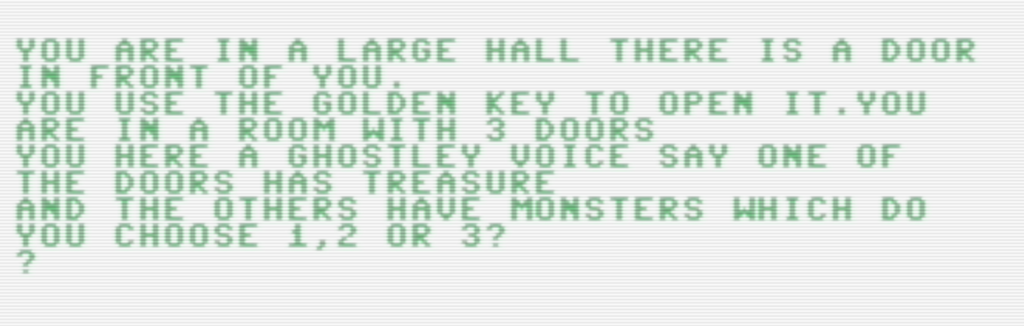
After that it is obvious what you need to do even if the parser makes it as difficult as possible to achieve.
Choose the right door and you are a millionaire. Game over.
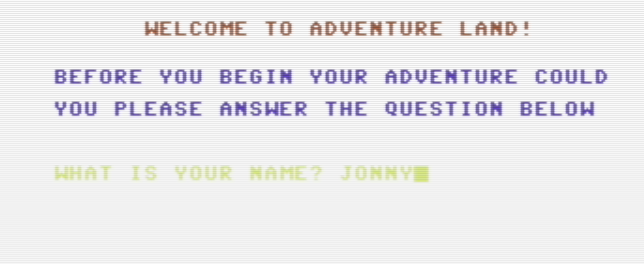
This is a terrible game. I only reviewed it and wrote it up as it was officially distributed through The Guild and is listed in GB64 and that is my remit. The parser is terrible, the game has what, 5 rooms in total and it’s incredibly easy to solve. Also, the colours!
One to skip, but at least its also one I can cross off the list. Onward and upward !