Adventure of Cleopatra’s Pyramid

This text adventure is from 1987 and was published by Falsoft Publishing, a publisher of magazines and books, primarily the Rainbow series, and it was in the third Rainbow Book of Adventures that this adventure first appeared. It was released for the TRS-80 Colour Computer and converted across to the C64 in the same year.
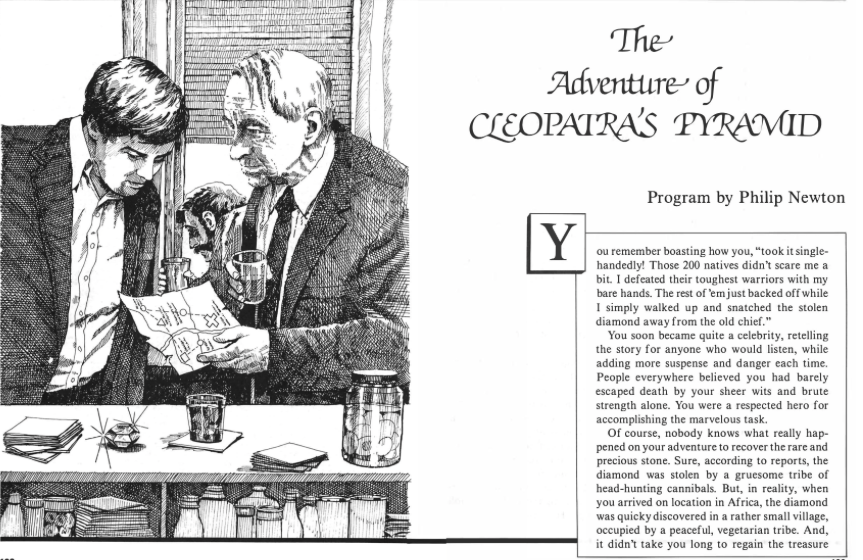
Philip Newton is attributed as the original author of the TRS-80 listing, and it looks like Nathan Butcher was involved (or wholly responsible) for the Commodore conversion. I could only find one listing for Philip Newton, this adventure, but Butcher appears to have many listings and releases under his name, mostly conversions, some of which we will no doubt cover in this series.

So, let’s start the adventuring….

We start at our camp, outside the tent and with all four major compass point exits available.

OK, so obvious first move, Enter Tent right? Nope.

I have to say, my heart sinks when this is the first thing you come across. I understand the limitations, believe me I do, but this stuff is important for a good experience. So, after typing VERB and having a look through the limited list, the only one that makes any sense is GO. So, Go Tent, of course.

All items appear to be randomly placed in one of two maze locations. The first maze location is the Hot, Sandy Desert, and is a bit of a nightmare. The map doesn’t really make any sense with random directions either taking you back to your camp or another hot, sandy stretch of dessert.
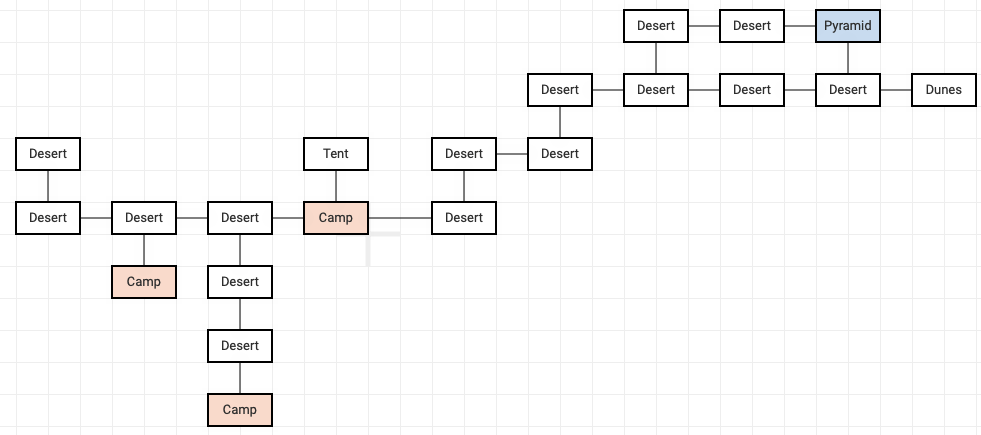
You’ll need to pick up all the objects you find along the way in the Desert, providing you don’t come across the Scorpion of course (it will eventually sting and slowly kill you) and make your way to the Pyramid for the next frustrating maze. You’ll need the FlashlightSceptre and Backpack before entering, which you should find in the Desert somewhere, and you should also have dropped all of the treasures found thus far back at the tent.

Once you make your way to the Pyramid, the game is made even more maddening by a randomised roaming mummy who can strip you of your inventory and scatter the items around in the catacomb maze. If you are lucky the mummy ignores you or simply shouts ‘Go Away!’. You can also wave your Sceptre at the mummy sometimes to make it disappear, but you need all the stars to align for this to happen, and you need to have found the items you need in the Desert without being killed by a random Scorpion. The fact you need to go back and forth makes it almost impossible to complete.

If you’re lucky!

I made quite a lot of use of the SAVE feature to stop getting killed or stripped of my possessions too frequently, but it soon became far too tedious to continue. I never did finish getting all 25 treasures back to my tent and quite honestly the sweet, lingering death of a scorpion sting was blessed relief.

It isn’t actually a bad game, certainly not the worst text adventure I have played, but the BASIC listing and typed in nature of the code kind of showed, and an attempt at being cutting edge with randomising mummies and scorpions just made for a frustrating experience. There was too much random luck involved and too little problem and logic solving for my liking.

Having said that, I am already sitting here thinking, well, I got 14 items….maybe I’ll try again for the full 25! I’ll give it some time and maybe revisit one day. That in itself might persuade you to give The Adventure of Cleopatra’s Pyramid a go…

Adventure Land The Guild

Another hobby (yes, I know! I have many hobbies) of mine is genealogy, and I get the same detective fix finding context about game authors and a little bit about where they are from and what they have done in their lives. It hasn’t taken many text adventure game reviews for me to start seeing a genealogical pattern forming for authors, software houses, distributors, labels etc.

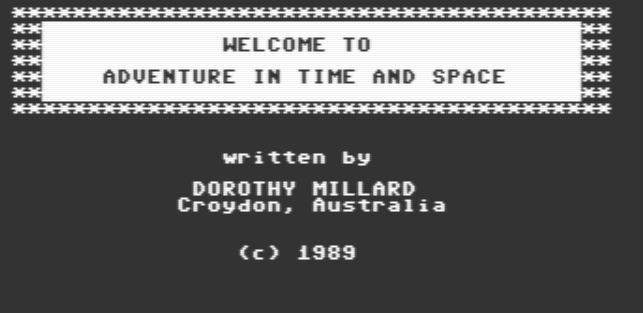
Adventure Land was distributed by The Guild, aka The Guild Adventure Software. We’ve already come across The Guild as it was they that distributed Dorothy Millard’s 1989 game Adventure In Time And Space. Distributed is the right word here, as they only published their own games from about 1991 and anything on their books before that date was either public domain or first published elsewhere.

When The Guild packed it in, a lot of their titles were snapped up by several houses, including Adventure Probe Software. The same Adventure Probe that published the magazines, including the one from my last post featuring J.B.Cattley. So in the course of three consecutive reviews we have a veritable family tree of software.

The Guild and Adventure Probe have links to The Adventure Workshop and Pegasus Software, as well as 50/50 Software and Recreation Re-Creation Software – all of whom have published or distributed text adventure games, so we will learn more about those as we come to them!

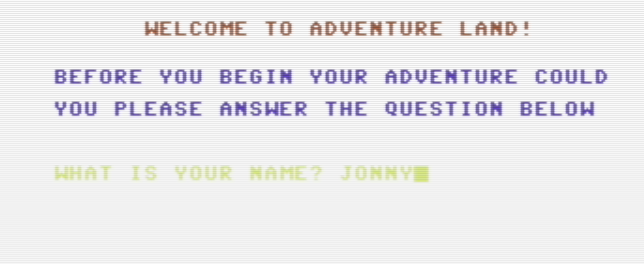
Adventure Land was written by Nick Corr, and I have failed miserably to find any firm information out about him. As far as I can tell he only wrote this single game, and I don’t think I am being too harsh when I say I can see why.

Arrrggghh my eyes!

So first off we are told our objective is to locate a golden key (yes, another one) which will enable us to enter a castle and claim our prize. We are warned of goblins and trolls and other magical creatures who are all hell bent on stopping us in our quest. We are also told to look out and memorise (I’ll write them down if that’s ok?) the magical words we may or may not find.

A clue to the complexity of the engine is that we are told we are only allowed one word commands. Fine.

We start in a forest. A large forest, with trees on all sides. Entering a command, any command, just repeats the short description of the forest. So I guess we just have to assume that we can’t do anything other than move in the directions it is telling us to go in. But even that is a challenge. The game will not accept E, W, S, or N – no you have to write the whole word. It took me way to long to realise that and I thought the game was simply broken, or deliberately nasty.

Anyway, you soon find that the forest is pretty unmappable and any old random directions eventually lead you to a field with a tree and lake in it. What do people do when they see a tree in an adventure game? Yep. And once you climb it you find the golden key already!

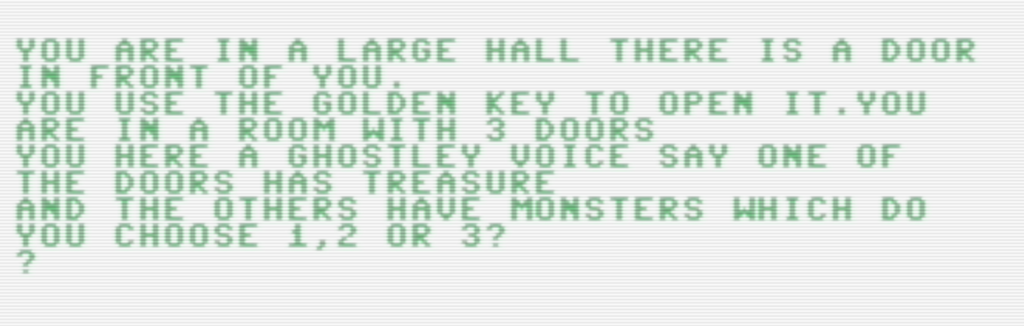
After that it is obvious what you need to do even if the parser makes it as difficult as possible to achieve.

Choose the right door and you are a millionaire. Game over.

This is a terrible game. I only reviewed it and wrote it up as it was officially distributed through The Guild and is listed in GB64 and that is my remit. The parser is terrible, the game has what, 5 rooms in total and it’s incredibly easy to solve. Also, the colours!

One to skip, but at least its also one I can cross off the list. Onward and upward !

Adventure Island

After a little break we’re back in the saddle, and heading off to Adventure Island.

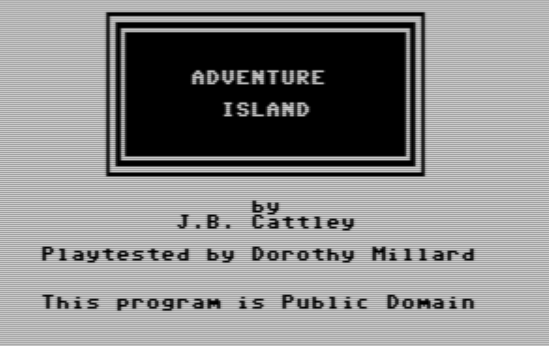
Adventure Island is a public domain game written by J.B.Cattley and playtested by none other than Ms Millard! This is the second time Dorothy Millard has popped up in this blog and I know it won’t be the last.

Adventure Island by J.B.Cattley

As I always like to get a little context and backstory on authors, I tried to find out a little bit about J.B.Cattley. There is a reference in a juggling group back from 1998 – I am making a huge assumption this is the same person, but somebody who used to enjoy writing text adventures on their beloved 8-bit computer is absolutely the sort of person who would end up on a juggling group.

Actually there is also a reference in a rogue like developers group from the same year too so pretty sure this is our guy.

A bit of a digression but I had no idea Google Groups was still going strong – this Commodore one (of which I am a member and have no memory of ever joining) is still really active!

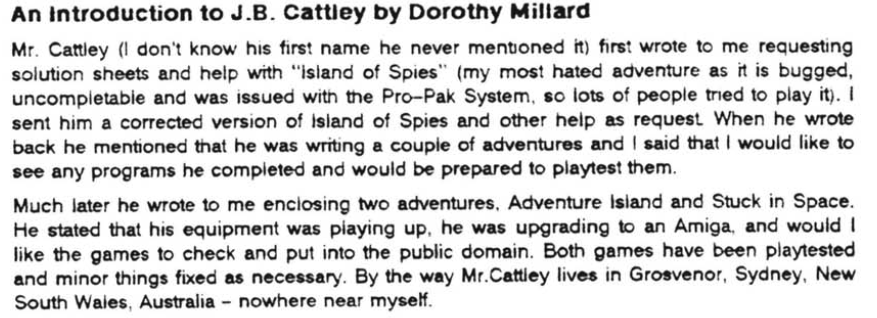
But, the best find of all was an article in Adventure Probe from December 1994, volume 8 issue 12.

I’ll put a link for you to download the PDF at the bottom of this post – I just love magazines/fanzines like these from those days. There was a fantastic global community formed around text adventure games and you really felt part of a scene. Just reading through this issue got me quite emotional!

The pertinent paragraph is written by, once again, Dorothy Millard – how I could go all these years without hearing her name before is beyond me. Anyway, here it is…

OK, on to the game itself.

You start off onboard the QE2 and are none too happy with how things have been going. This type of holiday is obviously not for you! Not to worry, it is but a matter of a few lines of text and you can say goodbye to this vacation as you are thrown overboard, where you have to swim to the eponymous Adventure Island.

Once you have slept off your ordeal you can have a look around and see if you can’t sort this situation out. It soon becomes obvious you’re in a very bad mood. Irritated by the beach, the cliffs, the boredom. Even the parser prompts are a bit snarky ‘Any more Brilliant Ideas?’ it asks you.

Going up and down the beach seems the only options open to you at the moment, but references to the cliffs to the north are obviously supposed to make you think – so experiment here with the objects you have found so far and one will help you on our way.

You will find yourself climbing cliffs, navigating gorges, slooshing through muddy bogs and feeding the local wildlife, before they start eating you! There is even, as Mr Cattley says in the description, a thicket to find, as every adventure game needs a thicket.

This is a fairly logical problem solver of a game, and you should be able to think your way through it apart from a couple of areas where help may be required. The map isn’t too big but you do need to open it up by utilising the things you find. Without that you won’t get very far. Almost everything you find strewn around the island has a use – there is one red herring but I’ll let you find that for yourself. Keeping tabs on the map is essential though as there is a good deal of doubling back.

If you get stuck, HELP brings up a list of verbs which are extremely useful – almost cheating – but without that I don’t see how you would guess the right words to use. The bridge problem in particular doesn’t make much sense to me, and it had to be done in a specific order.

There is actually a subtle clue in the opening text as to what you need to do at the end, and those cleverer than me will work that out. I had to use the help system again!

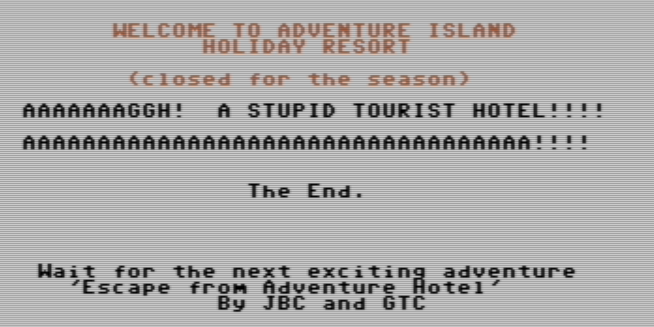
If you do make it to the end your ‘reward’ is to find yourself in a tourist hotel – your worse nightmare apparently!

End Screen of Adventure Island

Incidentally, Escape from Adventure Hotel mentioned at the end here, doesn’t appear to have ever been written – or at least I can’t find a reference to it anywhere.

The parser for Adventure Island is pretty basic and none too clever, but it’s ok and does the job well enough. It’s also fairly slow but again, acceptable.

I really enjoyed this adventure game, it had a really old school feel to it and I enjoyed it even more because it led me to the wonderful Adventure Probe magazines, which I am now going to read in their entirety! As promised, see the issue in question below. The map I did during my play through is also at the end of the post.

Thanks for reading, and until next time, keep safe out there adventurers!

Adventures In Time And Space

Adventure in Time and Space is the first text adventure on my list that was written by Dorothy Millard. I’d come across Dorothy’s name before, but I had never really looked into her or her backstory, so let’s start with that before we get onto the game itself.

Dorothy wrote 16 games in all, according to an interview from 1999 I read over at the Solution Archive site, plus a few she ‘fixed up’ for other people. She lived in Australia for many years but was born in England and, like me, started her love of computers with the Commodore 64. Early games were written in BASIC but she also wrote quite a few using The Quill, a system most of you will be familiar with, and one I am really trying to get to get grips with of late.

Alas, Dorothy’s website appears to be no more, but thankfully there are several early captures on the Wayback Machine, including all of her hand-typed solutions for many, many different adventure games! I am in the process of downloading all of those solutions to help preserve them – another backup can’t hurt!

If you want to read the whole interview you can do so here, but let’s turn our attention to the game itself.

The game, written in 1989, is in 2 parts of several sections each. It takes us to many different places, such as a deserted space station, medieval England, up into the Alps, a far-off planet, and the London suburbs, in our search for the golden key which has been stolen by ‘the evil time warrior’. We are told that in order to find the golden key we must first find the other 6 coloured keys.

We are called The Professor, and the game is about traveling through time and space in our time machine. So yeah, it’s unashamedly Doctor Who 🙂

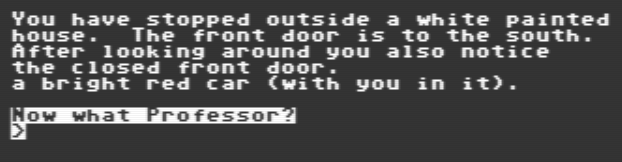
The game starts in the laboratory and we are already introduced to the professor’s time machine, although we can’t get in it yet. Have a good look around and examine everything here, but it soon becomes fairly obvious we need to leave here and go look outside. Like a lot of text adventures, you have the illusion of choice but really there is nowhere else to go but North to the car park and (I assume) the professor’s nice red car.

Again, examining is key, and once you’ve looked and picked up anything you find, you will make your way down the road, in the car, to a house.

This is a very good text adventure and really showcases, I think, the power of The Quill as an authoring solution. The Quill itself is quite tricky to get to grips with – something I am working on solving currently and I hope to release something into the wild soon!

It’s also very big – too big for me to go through each section and area, and too big really for a map – I did sketch one on paper as I played it through and will, one day, create that properly and include it here. Instead I need to try and review these text adventures in a new format otherwise I will never get through them all – some background info, a few screen shots, a bit of context etc. followed by a magazine style review.

One thing I do want to start including is my other passion, music. I’ll start including what I would be playing in the background in the month and/or year of release.

Thanks for reading, and feedback is welcome on the new format. I suspect it will keep getting tweaked as we go along – there are a LOT of adventures to get through.

Adventure In Time & Space: A large, complex text adventure. This one will take you a while to complete and really get you thinking. It’s an impressive title, and one that showcases The Quill to its full potential. A map is essential but it does get very complicated, especially with the time and location hopping.

Cavern Of Riches

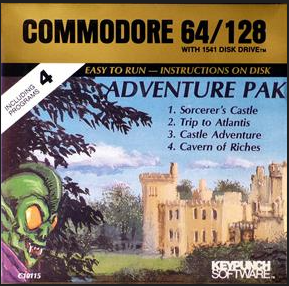
Cavern of Riches was one of four adventures on the Adventure Pak release from Keypunch Software. Keypunch was one of the first shareware distributors and ran from 1985 to 1993, also releasing commercial games during that time. They did other ‘Paks’ (Fantasy Pak, Challenger Pack, etc) and yes, sometimes they were ‘Paks’ and sometimes they were ‘Packs’! 

Cavern of Riches started life as a PET game in 1980 written by John O’Hare.

I guess this should come under ‘C’ really, but it is listed as Adventure 1 – Cavern of Riches in the GB64 catalogue, which was its original title on the PET I believe, so comes under ‘A’ in my self-imposed rules. The others, I think, are listed properly under their titles so I will come to them at some stage down the line.

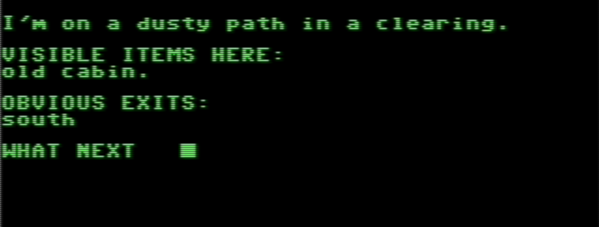
So Cavern of Riches starts off on a dusty path in a clearing and tells us you can see an ‘old cabin’. The aim of the adventure is to find 12 treasures, all with a ‘*’ in their name so we know they are treasures, of course (such as *trident*). We know little else at this stage, but we do know there is a cabin so it seems logical we should go inside and take a look around.

Here we learn that this cabin is where we are to deposit our treasures once we have found them, and there are a couple of useful objects here for us to pick up too.

On leaving the cabin and wandering around you’ll quickly come to a typical dungeon-like maze in a Forest – one of the ones where it matters very little which direction you moved in. You basically don’t move, unless you go in the correct direction that is. These sorts of mazes drove me mad as a kid trying to map them out, as you’re never quite sure if you’ve moved or stood still!

From here on in full spoiler alert. 

Once you find the first and easiest treasure, the Trident, you’ll enter this maze-like Forest and as long as you stick to going West you’ll end up where you need to be. At the end of the road is a building containing several items, one of which is an empty bottle to be filled with something no doubt. This is the first simple puzzle and it should be clear by now where some water is to fill our bottle up.

Once that’s done follow the road back to our ‘old building’ where you can find the trapdoor and enter the underground cavern. Now we’re talking! This is already the best text adventure by far I have played from the list, it’s fun, and I already have a true sense of the buildings and the forest with really quite minimal descriptions. That’s the skill of the adventure writer, I guess, and a good lesson to learn.

One thing to remember is you can only carry so much stuff, so tactical dropping and taking of objects is required.

Exploring underground and picking up treasures as you find them, you’ll come to a Deep Chasm where seemingly you can not proceed. But have wand will travel! Once you find your way over the chasm there is more magic to learn. Words that when said out loud will reveal treasures! Where you say these words is not clear at all, so you’ll need to experiment. 

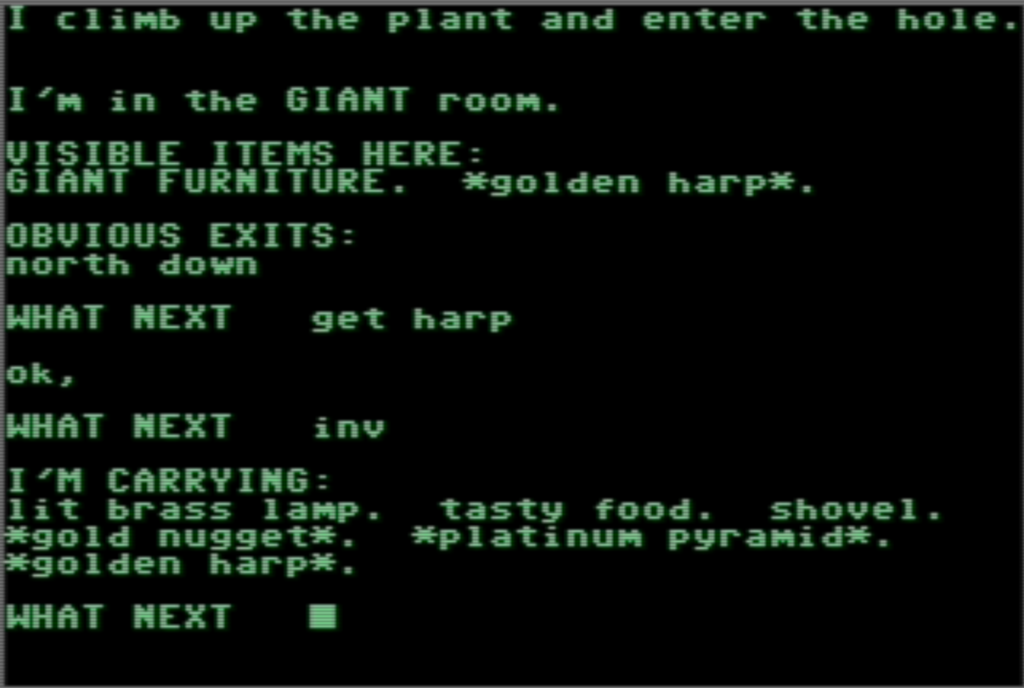
After some more exploring it becomes obvious what the water is for, and the bird you have been mysteriously carrying around too! Both are used to open up more areas of the underground caverns where more treasures can be found. You’ll eventually find a harp and harps are made to be played, so like the magic words, experiment on where to play the harp. If you find the right place you’ll come across another treasure, the plaque, which also contains a cryptic clue so make sure you read it.

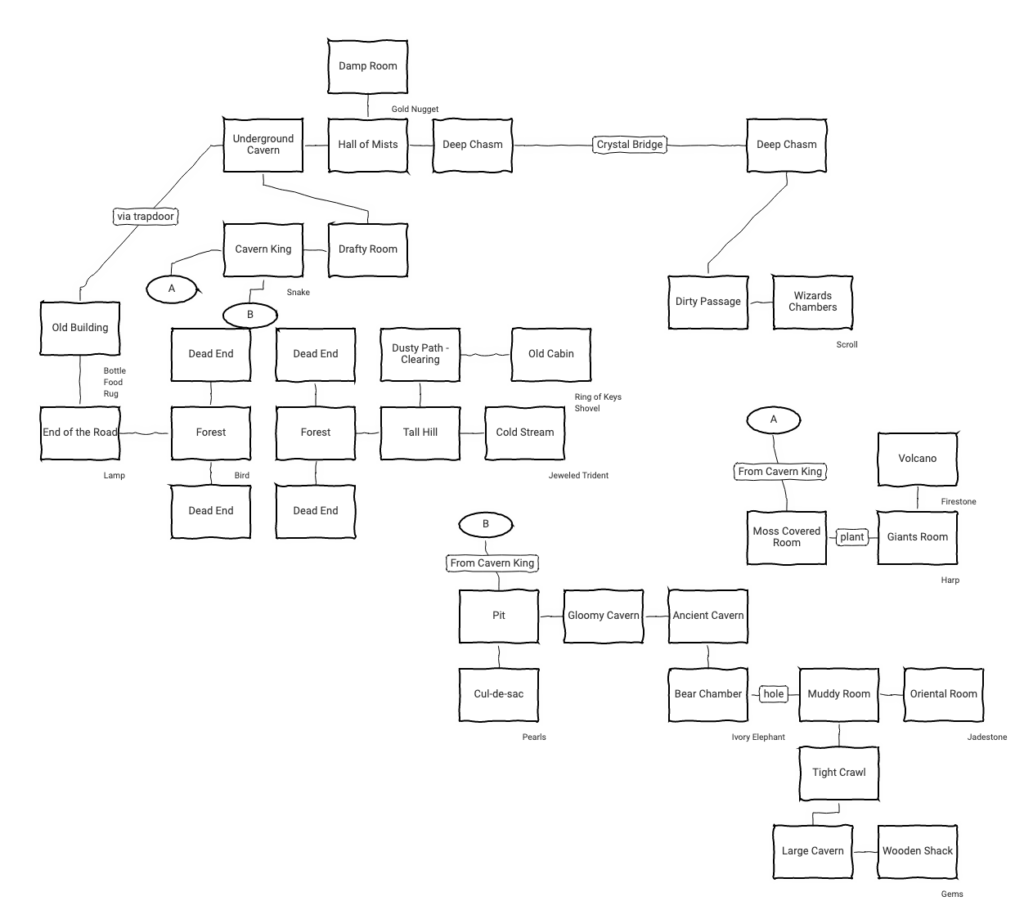
There is a lot of exploring and a map is essential here – see below for my full map! I make this sound like a quick and easy game, but I have deliberately left out a lot of detail as I do recommend you play this through, and you’ll enjoy working out the exact order to do things and the rooms to say the magic words in. On that note, you’ll find soon enough that you are stuffed so full of treasure that you’ll need to dump some off back at base. Thankfully, one of the magic words we discovered transports us straight there from a certain location and transports us back again when ready. A nice touch.

Depending on what order you locate the treasures you’ll need to zoom back and forth between the underground cavern and the old cabin. There is no location-based score here, you just earn points for each treasure dropped back in the right place, so it’s very possible to score the maximum 120 points to beat the game. So once you drop the final treasure just say ‘score’ and you’ll be congratulated and classed as an expert no less.

I really enjoyed Cavern of Riches and it totally reminded me of playing these games when I was younger. Armed with snacks, fizzy pop, paper and a pencil to draw the map, this was a true, old-school 80s text adventure. Change the fizzy pop to a bottle of wine and the pencil and paper to an online map creation tool, and nothing much else has changed. 

The puzzles are all logical and solvable, nothing is a red herring so if you come across an object you will have to use it somewhere and it is nearly always obvious where that is, or what you need to find. What is less obvious is where you say the magic words. That, as far as I can tell, is only apparent through trial and error. I wouldn’t say that was a frustration as such, but it did increase the time it took me to complete the game. As mentioned above, the world we explore is created wonderfully, with very little wasted text. I think the length of the game helps to conjure up the universe we play in – quick and small games don’t really give the player time to immerse themselves into the story, but Cavern shows that minimal text and saving that precious memory for the story really works. It’s a balancing act.

I got the file from GB64 and the full database ISO images, but it is available elsewhere too. Be warned that some C64 versions have a scoring bug, but mine did not, so if you can do use the one on GB64.

I’m looking forward to playing the rest of this Adventure Pak now but have to say, the bar has been set pretty high with Cavern of Riches.